Chapter 0: Purpose and Learning Objectives of This Textbook
Product Covered in This Textbook
The official name of "Smart Assist" covered in this textbook is AUTION EYE Smart Assist (ARKRAY, Inc.). It is a cloud-based remote assessment support service that operates in conjunction with the fully automated urine formed element analyzer AUTION EYE AI-4510, supporting urine sediment examination workflows at medical institutions. In this textbook, it is referred to simply as "Smart Assist."
| Item | Details |
|---|---|
| Official Name | AUTION EYE Smart Assist |
| Manufacturer | ARKRAY, Inc. |
| Connected Device | AUTION EYE AI-4510 (Fully Automated Urine Formed Element Analyzer) |
| Service Type | Cloud-Based Remote Assessment Support Service |
0.1 Why This Training Is Necessary
Smart Assist is a cloud-integrated service that supports laboratory testing operations at medical institutions. Image data output by the fully automated urine formed element analyzer AUTION EYE AI-4510, manufactured by ARKRAY, Inc., is transmitted to a cloud environment outside the hospital. Remote medical technologists then classify and verify the results, which are returned to the AUTION EYE within the hospital.
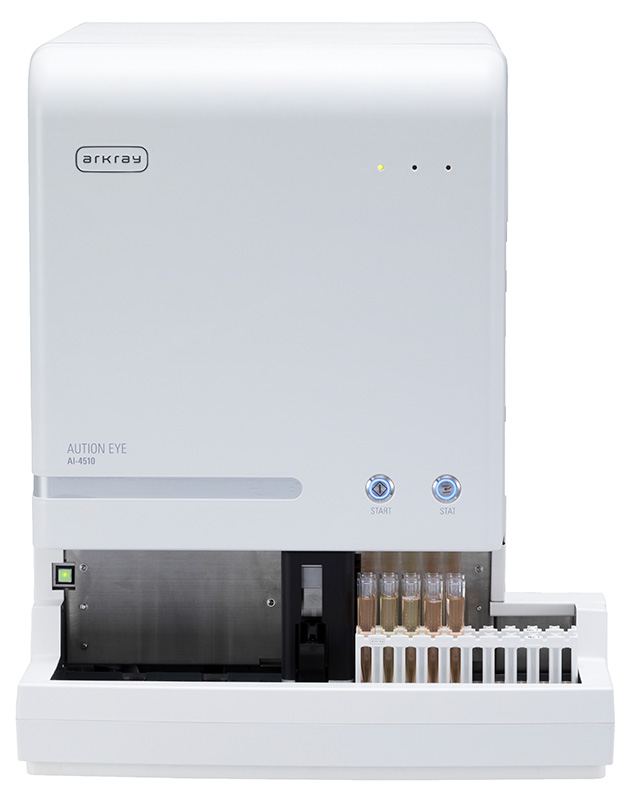
AUTION EYE AI-4510 (Fully Automated Urine Formed Element Analyzer, manufactured by ARKRAY, Inc.)
From a technical perspective, this system involves a complex interplay of the following elements:
- Connection with medical devices (AUTION EYE, LIS, electronic medical records)
- Compliance with hospital network security policies
- Cloud communication via the internet
- Regulatory requirements regarding the handling of medical data
Engineers responsible for the deployment, operation, and troubleshooting of Smart Assist need not only networking expertise but also the ability to make informed decisions within the context of healthcare IT.
However, in practice, the following challenges exist:
| Challenge | Specific Example |
|---|---|
| Unaware of constraints specific to healthcare IT | Unable to explain why hospital networks are isolated |
| Does not understand the intent behind communication design | Unable to accurately explain the meaning of "Outbound Only" |
| Unable to communicate with hospital IT staff | Cannot answer expected questions during security reviews |
| Unable to isolate issues during incidents | Cannot determine whether the problem lies with DNS, proxy, or TLS |
This textbook aims to systematically address these challenges, enabling engineers involved with Smart Assist to perform their duties independently.
0.2 The Social Role of Smart Assist
Structural Problems Facing the Healthcare Field
Medical institutions around the world, particularly small and medium-sized hospitals and clinics, are finding it increasingly difficult to secure clinical laboratory technologists. Tests such as urine sediment examination, which require microscopic assessment skills, are highly dependent on experienced technologists.
As a result, the following problems have arisen:
- Uneven distribution of personnel — Technologists are concentrated in urban areas, while rural and remote regions face chronic shortages (e.g., remote islands and rural areas in Japan, rural regions in the United States, rural areas in the EU)
- Difficulty maintaining nighttime and weekend coverage — Many facilities cannot sustain 24-hour laboratory operations
- Inconsistent assessment quality — Because assessments depend on individual technologist experience, standards vary between facilities
Value Provided by Smart Assist
Smart Assist provides the following value in response to these structural problems:
| # | Value of Smart Assist | Details |
|---|---|---|
| 1 | Elimination of geographic constraints | Remote laboratory technologists provide assessment support |
| 2 | Reduction of time constraints | Assessment support is available during nights and weekends (*Note: nighttime and weekend service is not currently offered) |
| 3 | Standardization of assessment quality | Unified assessment standards provided by experienced technologists |
Why Network Engineers Are Important
The value of Smart Assist can only be realized when communication between in-hospital medical devices and the cloud environment is "safe and reliable." If communication stops, laboratory operations stall, potentially affecting patient diagnosis.
In other words, Smart Assist network engineers do not simply build and maintain IT infrastructure — they play a role in ensuring the continuity of healthcare services.
0.3 Target Engineer Profile
Upon completing this textbook, the goal is to become an engineer equipped with the following capabilities.
Technical Capabilities
| Domain | Learning Objective |
|---|---|
| Network Fundamentals | Ability to accurately explain IP addresses, subnets, DNS, TCP/HTTPS, TLS, and NAT |
| Communication Design Comprehension | Ability to diagram the Smart Assist communication sequence and explain the purpose of each step |
| Firewall Design | Ability to accurately design and request FQDN allowlisting, port opening, and proxy configuration |
| Cloud Fundamentals | Ability to explain the roles of AWS VPC, Security Groups, and load balancers |
| Troubleshooting | Ability to independently isolate issues using ping, nslookup, and curl |
Professional Competencies
| Domain | Learning Objective |
|---|---|
| Healthcare IT Understanding | Ability to understand the structure and constraints of hospital networks and design accordingly |
| Client Communication | Ability to respond to hospital IT staff security reviews with well-founded answers |
| Deployment Operations | Ability to lead the process from initial assessment through test communication to production cutover |
| Incident Response | Ability to perform initial triage during incidents and escalate appropriately |
| Regulatory Understanding | Ability to understand the outlines of medical information regulations in each country — Japan: Three-Ministry Two-Guideline Framework (Japan's medical data protection guidelines), United States: HIPAA/HITECH, EU: GDPR/MDR — and make informed decisions regarding data handling |
Topics Not Covered in This Textbook
This textbook focuses specifically on training network engineers involved with Smart Assist. The following topics are out of scope:
- Hardware maintenance and operation of the medical device (AUTION EYE)
- Application development for LIS or electronic medical records
- Service development and deployment procedures on AWS
- The assessment work performed by clinical laboratory technologists
In the next chapter, we will take a bird's-eye view of the overall medical information system landscape that Smart Assist interacts with, and understand the role and relationships of each component.