Chapter 1: Overview of Medical Information Systems
1.1 Characteristics of Medical Devices
Medical devices possess characteristics that differ from general IT equipment. Engineers involved with Smart Assist need to properly understand these differences.
Differences from General IT Equipment
| Aspect | General IT Equipment | Medical Devices |
|---|---|---|
| Regulation | Generally none (some industry-specific regulations exist) | Approval required under each country's medical device regulations (Japan: PMD Act, US: FDA 510(k)/PMA, EU: EU MDR/CE Marking) |
| Software Updates | Can be updated at any time | Changes outside the approved scope are generally not permitted |
| Network Connectivity | Configuration can be freely changed | Careful procedures are required for connectivity changes |
| Impact of Failures | Business delays | May directly affect patient diagnosis and treatment |
| Service Life | Approximately 3–5 years | Often used for 7–10 years or more |

FDA (U.S. Food and Drug Administration)

EU MDR / CE Marking
Mindset When Working with Medical Devices
Medical devices are "equipment that can affect patients' lives." Even though engineers directly work with communication paths and network settings, beyond those lie patient specimen data and physician diagnoses.
When making configuration changes or troubleshooting, always keep the following in mind:
- Always record the current state before making changes (setting values, IP addresses, connection status, etc.)
- Do not change settings without hospital approval
- Avoid times when laboratory operations are active (change work should in principle be performed during testing downtime)
1.2 The Role of AUTION EYE
AUTION EYE is a fully automated urine formed element analyzer manufactured by ARKRAY, Inc. It is the starting point for Smart Assist data, and understanding the role of this instrument is the first step in understanding the overall system.
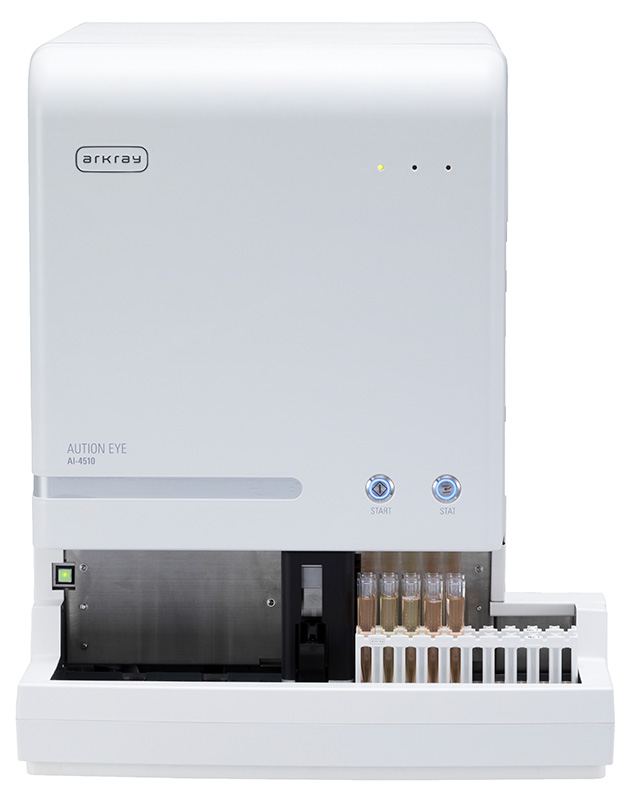
AUTION EYE AI-4510
Note (International Context): ARKRAY, Inc. is a Japanese IVD (in vitro diagnostics) manufacturer. In the field of urine sediment analysis, global manufacturers such as Sysmex, Siemens Healthineers, Beckman Coulter, and Roche also offer similar instruments. This textbook focuses on AUTION EYE as the foundation of the Smart Assist service, but the technical concepts of cloud-linked analysis services are applicable to other instruments as well.

Sysmex

Siemens Healthineers

Beckman Coulter

Roche
What AUTION EYE Does
- Urine Specimen Aspiration — Automatically aspirates the patient's urine specimen
- Image Capture — Microscopically photographs formed elements in the urine (red blood cells, white blood cells, epithelial cells, casts, etc.)
- Automatic Classification (Primary Determination) — AI automatically classifies the captured images
- Result Output — Outputs classification results as data
Limitations of Automatic Classification
AUTION EYE's automatic classification is highly accurate, but it cannot produce a definitive determination for every image. In the following cases, the determination is held as "Unconfirmed":
- Images where components overlap and are difficult to identify
- Rare components with low occurrence frequency
- Cases where the automatic classification confidence score falls below the threshold
This "Unconfirmed" data is precisely what Smart Assist is designed to resolve.
1.3 LIS (Laboratory Information System)
What Is LIS?
LIS (Laboratory Information System) is an information system used in the Laboratory Department within a hospital. It centrally manages everything from receiving test orders to reporting results.
Main Functions of LIS
| Function | Description |
|---|---|
| Order Reception | Receives test orders from the Electronic Medical Record (EMR) |
| Specimen Management | Barcode management of specimens, specimen tracking |
| Result Reception | Receives test results from each analyzer |
| Result Verification | Automatic verification such as abnormal value checks and comparison with previous values |
| Result Reporting | Sends confirmed results to the Electronic Medical Record (EMR) |
Network Architecture of LIS, EMR, and Analyzers
In an actual hospital, the LIS is connected to the Electronic Medical Record (HIS) via the hospital LAN, and is also connected by LAN to numerous analyzers in the laboratory. The diagram below shows a typical network architecture centered on the LIS.
Key points of the diagram above:
- The Electronic Medical Record (HIS) is positioned at the upper center, with LIS, PACS, and the Physiological Testing System connected in parallel
- The key functions of LIS (Test Order Management, Specimen ID Management, Result Aggregation, HIS Integration) are shown in the middle section
- Laboratory analyzers are connected to LIS via the hospital LAN
- Smart Assist is located in the external cloud (Internet Zone), separated from the hospital LAN zone by a firewall
- AUTION EYE sends results to LIS (Smart Assist results also go through AUTION EYE and are not returned directly to LIS)
Relationship with Smart Assist
As shown in the diagram above, Smart Assist does not communicate directly with LIS. The data flow is always "Smart Assist → AUTION EYE → LIS → Electronic Medical Record", and the LIS server is placed in the laboratory segment of the hospital network.
1.4 Electronic Medical Record
What Is an Electronic Medical Record?
The Electronic Medical Record (EMR: Electronic Medical Record / EHR: Electronic Health Record) is a system that electronically manages patient clinical information. It serves as the core information infrastructure when physicians perform diagnosis and treatment.
Terminology Note: In Japan, the term "Electronic Medical Record" (電子カルテ) is the common designation. In the United States, EHR (Electronic Health Record) is the standard term, with Epic, Oracle Health (formerly Cerner), and MEDITECH being major vendors. In Europe, it is sometimes called EPR (Electronic Patient Record), and systems and terminology vary by country.

Epic Systems

Oracle Health (formerly Cerner)
Role of the Electronic Medical Record in Laboratory Operations
The role of the Electronic Medical Record in laboratory testing is, as shown in the architecture diagram in Section 1.3, to bidirectionally exchange orders and results with the LIS.
- Test Order Issuance — The physician orders a test on the Electronic Medical Record, which is sent to the LIS
- Result Review — Test results are returned to the Electronic Medical Record via the LIS, and the physician reviews the results
- Diagnosis Recording — The diagnosis based on test results is recorded in the Electronic Medical Record
What Smart Assist Engineers Need to Know
Smart Assist engineers do not directly operate the Electronic Medical Record. However, they need to understand the following points:
- The Electronic Medical Record is the most confidential system and is placed in the most protected segment of the hospital network
- Smart Assist's communication path is designed to not directly connect to the Electronic Medical Record's segment
- Test results always reach the Electronic Medical Record via the LIS
1.5 Standard Laboratory Data Flow
It is important to understand the standard laboratory data flow without Smart Assist. This is the base configuration, and Smart Assist is "added" to this base configuration as an intermediary.
Standard Flow (Without Smart Assist)
Step Details:
| Step | Description |
|---|---|
| 1. Order Issuance | Physician orders a urinalysis on the Electronic Medical Record |
| 2. LIS Reception | LIS receives the test order and assigns a Specimen ID |
| 3. Specimen Loading | Lab technician loads the specimen into AUTION EYE |
| 4. Capture & Analysis | AUTION EYE automatically performs image capture and classification |
| 5. Result Transmission | Classification results are sent to LIS |
| 6. Technician Review | Lab technician reviews and approves results on the LIS |
| 7. Result Reporting | Results are sent from LIS to the Electronic Medical Record |
| 8. Physician Review | Physician reviews the test results on the Electronic Medical Record |
In this flow, everything is completed within the hospital network. No external communication occurs whatsoever.
1.6 The Exact Position Where Smart Assist Intervenes
Smart Assist intervenes between Steps 4 and 5 in the standard flow described above. Specifically, it operates only on image data that AUTION EYE has determined to be "Unconfirmed."
Flow with Smart Assist
Summary of the Exact Intervention Position
| Element | Relationship with Smart Assist |
|---|---|
| Electronic Medical Record | No direct relationship (receives results indirectly via LIS) |
| LIS | Final recipient of all results (sent from AUTION EYE) |
| AUTION EYE | Performs image capture and auto-classification, and also hosts the Smart Assist client. Confirmed results are sent directly to LIS. Unconfirmed data is sent to the cloud, and the returned confirmed results are also sent to LIS. When a microscopy flag is received, the process is handed off to microscopy examination in the laboratory |
| AWS Cloud | Receives unconfirmed images and returns remote technician classification results to AUTION EYE. Returns a microscopy flag when classification is not possible |
| Microscopy | Performed in the laboratory when Smart Assist also cannot make a determination; results are registered directly into LIS |
Key Points Engineers Must Understand
- Smart Assist is a supplementary intervention for unconfirmed data — It does not replace the entire testing workflow
- External communication occurs only for unconfirmed data — Confirmed data is completed within the hospital as before (refer to the architecture diagram in Section 1.3)
- Communication always originates from the hospital side — No inbound connections from the cloud to the hospital occur (Outbound Only)
In the next chapter, we will further break down Smart Assist's operational flow and provide a technical understanding of each step from automated analysis to result return.